Predict • Prevent • Treat Disease
Predict • Prevent • Treat Disease

From preconception screening and non-invasive prenatal testing to whole exome sequencing and precision oncology, our specialized laboratory delivers actionable genomic reports grounded in ACMG guidelines.
Answer 2 quick questions to identify the clinically recommended NGS panel, sample tube, and turnaround time.
NIPT, Down Syndrome, Carrier screening & POC
BRCA1/2, Lynch Syndrome & Tumor profiling
Exome sequencing, syndromic delays & CMA
Cardiomyopathy, Ataxia, Neuropathy panels
Drug sensitivity, metabolism & toxicity profiling
Evaluate your personal and family history indicators to estimate your hereditary risk tier and identify clinically actionable genetic tests.
Breast, Ovarian, Colon, Pancreatic, or Lynch Syndrome
HCM, DCM, Long QT, Brugada, or unexplained syncope
Recurrent pregnancy loss, IVF preparation, Thalassemia, SMA
Developmental delay, autism, neuromuscular, metabolic
We provide prospective parents and obstetricians with advanced non-invasive and invasive genomic diagnostics to assess chromosomal and monogenic risks early in pregnancy.
Screens cell-free fetal DNA from maternal blood for Trisomy 21 (Down Syndrome), 18 (Edwards), 13 (Patau), sex chromosome aneuploidies (Turner, Klinefelter), and microdeletions from as early as 9 weeks. Sensitivity >99%.
Pre-conceptional screening for asymptomatic carriers of severe autosomal recessive and X-linked conditions (Beta-Thalassemia, Spinal Muscular Atrophy, Cystic Fibrosis, CAH, Fragile X).
Evaluates chromosomal causes of recurrent miscarriage and fetal loss without maternal cell contamination artifacts.
Gold-standard Next-Generation Sequencing platforms enabling diagnostic closure for children and adults with unexplained syndromic, neurological, or metabolic disorders.
Exonic capture of ~20,000 coding genes with >100x mean depth. Trio sequencing (Proband + Parents) enables rapid de novo and compound heterozygous variant identification.
High-depth sequencing targeting all medically characterized human disease genes in the OMIM catalog. Cost-effective first-tier test for heterogeneous presentations.
Complete sequencing of the 16.5 kb mitochondrial genome to identify low-level heteroplasmy in Leigh syndrome, MELAS, and mitochondrial myopathies.
Empowering oncologists and patients with precision risk stratification, PARP-inhibitor qualification, and targeted therapeutic roadmap profiling.
Full gene sequencing and MLPA CNV analysis for BRCA1, BRCA2, PALB2, TP53, PTEN, CDH1, CHEK2, and ATM for risk assessment and surgical planning.
Analyzes mismatch repair genes MLH1, MSH2, MSH6, PMS2, EPCAM, APC, and MUTYH for familial polyposis and non-polyposis colorectal cancer syndromes.
High-depth FFPE tissue tumor profiling evaluating actionable mutations and fusions in EGFR, KRAS, BRAF, ALK, ROS1, RET, NTRK, PIK3CA, and ERBB2.
Targeted multigene panels identifying causal mutations in inherited sudden cardiac death syndromes, cardiomyopathies, and progressive neuromuscular disorders.
Evaluates Hypertrophic Cardiomyopathy (MYH7, MYBPC3), Dilated Cardiomyopathy (TTN, LMNA), Long QT Syndrome (KCNQ1, KCNH2, SCN5A), and Brugada Syndrome.
Covers Limb-Girdle Muscular Dystrophies, Charcot-Marie-Tooth neuropathies, Hereditary Spastic Paraplegia, and Spinocerebellar Ataxias.
Early genetic identification enables proactive ICD (Implantable Cardioverter-Defibrillator) placement, targeted beta-blocker therapy, and cascade family member screening.
Eliminating trial-and-error prescribing. Our PGx panel tests over 25 critical drug metabolism enzymes to guide dosage and prevent life-threatening adverse drug reactions across 150+ common drugs.
High-resolution cytogenomic solutions for chromosomal structural anomalies, balanced translocations, microdeletions, and unexplained infertility.
High-density SNP array detecting copy number variations (CNVs) and loss of heterozygosity (LOH) with sub-kilobase resolution.
Classical cytogenetic analysis of all 46 chromosomes for translocations, inversions, and marker chromosomes in recurrent pregnancy loss and primary amenorrhea.
Side-by-side comparison of diagnostic yield, target gene resolution, specimen requirements, and turnaround times to aid test selection.
| Diagnostic Feature | Whole Exome (WES) | Clinical Exome (CES) | Chromosomal Microarray (CMA) | Targeted Panels | Karyotyping |
|---|---|---|---|---|---|
| Target Genes & Loci | ~20,000 Coding Genes | 6,500+ OMIM Curated Genes | 750,000+ Oligo-SNP Probes | 10 – 200 Disease Genes | All 46 Chromosomes |
| Variant Types Detected | SNVs, InDels, Exonic CNVs | SNVs, Small InDels | Sub-microscopic CNVs & LOH | Deep SNVs, InDels, Fusions | Large Aneuploidies (>5Mb) |
| Mean Sequencing Depth | > 100x Target Coverage | > 100x Target Coverage | N/A (Array Hybridization) | > 500x Ultra-Deep NGS | 550+ Band Level |
| Diagnostic Yield | 35% – 45% (Trio Analysis) | 25% – 35% | 15% – 20% (First-Line) | 30% – 50% (Organ-Specific) | 3% – 5% |
| Specimen Tube | 3-5 ml EDTA Blood | 3 ml EDTA Blood | Blood / Amniotic / CVS | EDTA Blood / FFPE Tissue | Sodium Heparin Blood |
| Turnaround Time | 14 – 18 Working Days | 12 – 15 Working Days | 10 – 12 Working Days | 10 – 14 Working Days | 10 – 14 Working Days |
| Quick Action |
Explore how 5-tier clinical pathogenicity scores are computed using standard ACMG criteria combinations.
Confirmed high-penetrance disease-causing variant. Initiate targeted clinical management, surveillance protocol, cascade testing for first-degree relatives, and pre-test genetic counseling.
Discover how genetic polymorphisms in drug metabolism enzymes dictate clinical drug efficacy, adverse reaction risks, and CPIC dosing guidelines.
Reduced biotransformation to active thiol metabolite leading to subtherapeutic platelet inhibition and increased risk of Major Adverse Cardiovascular Events (MACE) and Stent Thrombosis.
CPIC Level A: Avoid clopidogrel. Prescribe alternative antiplatelet agent (Prasugrel or Ticagrelor) in absence of contraindications.
Explore the high-throughput sequencing systems, automated capillary analyzers, and computational genomics servers powering our Vizag facility.
Powers our Whole Exome, Clinical Exome, and Non-Invasive Prenatal Testing (NIPT) workflows with unprecedented depth, uniformity of coverage, and base calling fidelity.
Browse our full searchable test directory or speak directly with our clinical genetics team in Visakhapatnam.
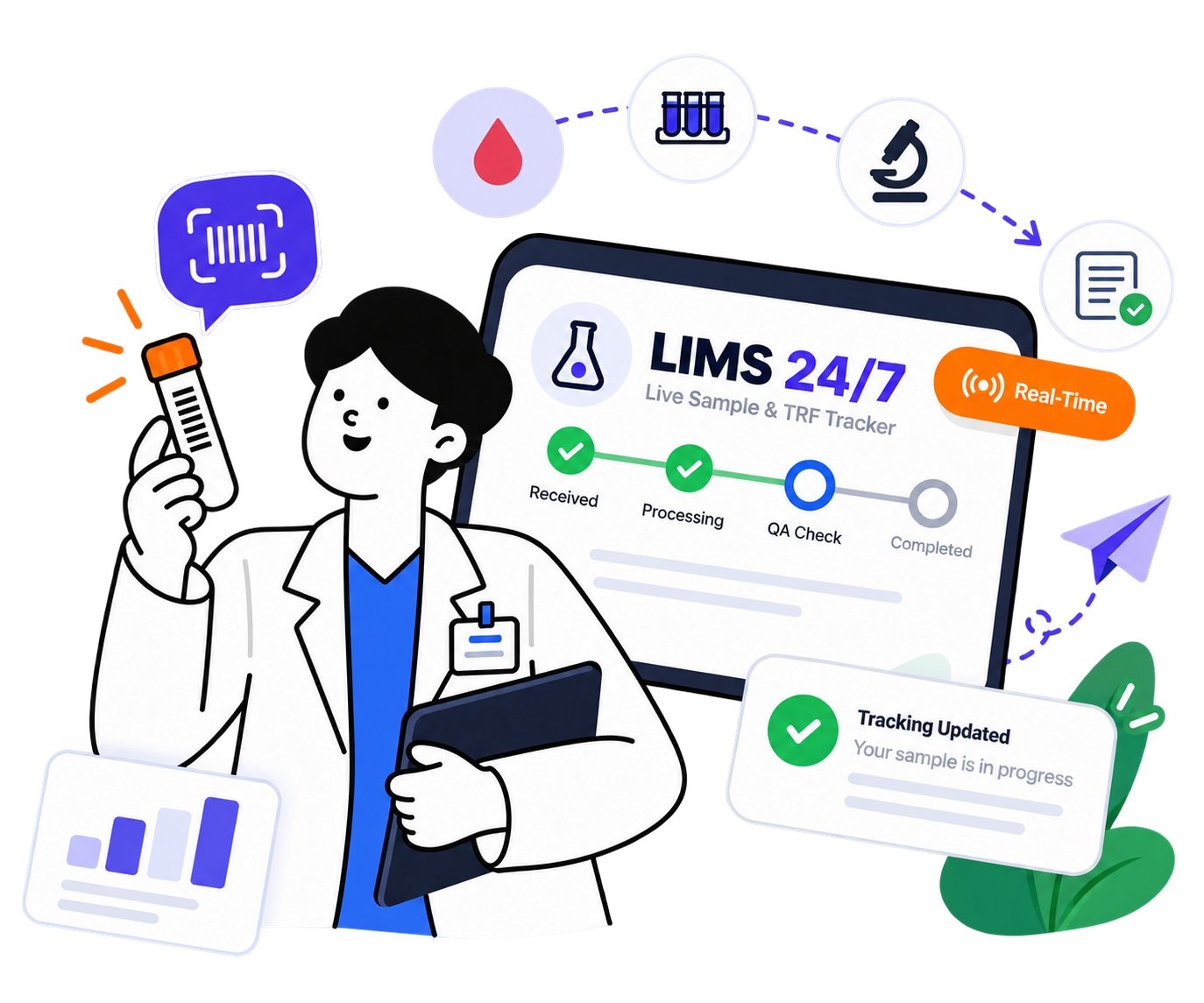
Enter a Barcode or select a Demo Barcode above
Real-time status updates are synchronized with our Central Accessioning LIMS in Visakhapatnam.